10 Best Grocery Delivery Mobile Apps in India for 2026
Updated - May 14, 2026 at 11:14 am | 13614 Views
In 2026, the Indian grocery delivery industry has witnessed remarkable growth, driven by urbanization, changing consumer behaviors, and the adoption of digital technology. With the rise of instant deliveries and convenient shopping options, online grocery delivery apps have become an integral part of daily life for many people across India.
If you’re looking for the best grocery delivery apps in India this year, here’s a list of top 10 grocery apps that provide a great shopping experience, fast deliveries, and a wide range of products.
1. BigBasket
Best For: Variety of groceries and pantry essentials
Available In: Nationwide (major cities across India)
Overview: One of the largest and most popular grocery delivery apps in India, BigBasket offers a massive selection of fresh produce, dairy, snacks, and household items. They provide both next-day delivery and same-day delivery options, depending on the location.
Key Features:
Extensive product catalog with organic, gourmet, and international options
Subscription-based plans for regular deliveries
Easy re-ordering and personalized suggestions
Delivery Time: Same-day, next-day, or scheduled
Payment: Debit/Credit cards, UPI, Net Banking, Cash on Delivery (COD)
Why It’s Great: BigBasket is well-established, and its wide range of groceries makes it a reliable option for regular shoppers.
Available In: Major urban cities in India (Delhi, Mumbai, Bangalore, etc.)
Overview: Blinkit (formerly Grofers) has become synonymous with ultra-fast grocery deliveries, offering products within 10 to 30 minutes in select areas. It’s perfect for those who need last-minute groceries or daily essentials.
Key Features:
10-minute delivery in select locations
Wide selection of everyday products and fresh items
Affordable prices and great discounts
Delivery Time: 10-30 minutes (select cities)
Payment: Debit/Credit cards, UPI, Wallets
Why It’s Great: Blinkit’s ability to offer instant delivery in urban locations is a game-changer for busy consumers.
Available In: Major cities in India (Mumbai, Delhi, Bangalore, etc.)
Overview:Zepto specializes in providing super-fast grocery deliveries—often within 10 minutes. The app caters to people looking for last-minute purchases and those who want quick access to fresh produce and daily essentials.
Key Features:
10-minute delivery service
Easy-to-navigate app and hassle-free payment
High-quality fresh produce and pantry staples
Delivery Time: 10 minutes in select cities
Payment: Debit/Credit cards, UPI
Why It’s Great: Zepto’s speed makes it perfect for those who need items quickly, and it has become a favorite in urban hubs.
Overview: As part of the global Amazon ecosystem, Amazon Pantry offers a comprehensive grocery shopping experience with a vast range of products from pantry essentials to fresh foods. It also allows bulk buying and competitive prices.
Key Features:
Bulk buying and affordable pricing
Prime members get faster delivery
Seamless integration with Amazon
Delivery Time: Same-day, next-day, or scheduled
Payment: Amazon Pay, Debit/Credit cards
Why It’s Great: Amazon Pantry integrates with Amazon Prime, making it easy for Prime members to get their groceries delivered with added benefits like faster delivery.
Overview: JioMart is an initiative by Reliance Industries to offer a wide range of grocery items at affordable prices. It connects local kirana stores to customers, ensuring fresh deliveries directly from local shops.
Key Features:
Affordable prices and local kirana store integration
Wide product catalog ranging from groceries to home essentials
Jio loyalty benefits for discounts
Delivery Time: Same-day or next-day delivery
Payment: Debit/Credit cards, UPI, JioMoney
Why It’s Great: JioMart’s ability to connect users with local stores makes it unique and perfect for customers seeking competitive pricing.
Best For: Early morning deliveries of milk and essentials
Available In: Delhi NCR, Bangalore, Hyderabad, Mumbai
Overview: MilkBasket is tailored for those who need daily deliveries, especially milk and other early morning essentials. It allows customers to set up subscriptions and get regular deliveries of fresh items every day.
Key Features:
Early morning deliveries (6-7 AM)
Subscription-based plans for regular products
Focus on fresh and organic products
Delivery Time: Morning delivery (early AM)
Payment: Debit/Credit cards, UPI, Wallets
Why It’s Great: Perfect for those who want a regular supply of daily essentials without having to worry about going out.
Best For: Comprehensive online grocery shopping experience
Available In: Major cities across India
Overview: Flipkart Supermart is Flipkart’s grocery arm, offering a range of grocery items, fresh produce, dairy, snacks, and beverages. Customers can shop for essentials at competitive prices.
Key Features:
A wide range of grocery and household items
Integration with Flipkart’s main app for a seamless experience
Regular discounts and offers for Flipkart Plus members
Delivery Time: Same-day or next-day delivery
Payment: Flipkart Pay, Debit/Credit cards, UPI
Why It’s Great: Flipkart Supermart combines variety with affordability, making it a solid choice for regular grocery shoppers.
Best For: Premium, organic, and gourmet grocery shopping
Available In: Major cities like Mumbai, Delhi, Bangalore
Overview: Nature’s Basket focuses on high-quality products, including organic items, international brands, and gourmet foods. It’s a premium grocery delivery service with a curated selection.
Key Features:
Specializes in organic and gourmet foods
International product selection
Same-day delivery in select cities
Delivery Time: Same-day delivery (in select locations)
Payment: Debit/Credit cards, UPI, Wallets
Why It’s Great: Ideal for customers seeking premium, organic, and international grocery options.
Best For: Multi-category delivery and hyperlocal shopping
Available In: Major cities (Delhi, Bangalore, Mumbai, etc.)
Overview: Dunzo is known for delivering not only groceries but also food, medicines, and other essentials. The app uses a hyperlocal delivery model, enabling it to deliver items quickly from local stores.
Key Features:
Hyperlocal delivery of groceries and more
On-demand delivery (fast deliveries within hours)
Wide selection of products
Delivery Time: Usually within 1 hour
Payment: Debit/Credit cards, UPI, Wallets
Why It’s Great: Dunzo is a versatile app that offers multi-category deliveries and focuses on fast service.
Available In: Cities like Mumbai, Pune, Bangalore, Hyderabad
Overview: Supr Daily focuses on delivering fresh milk, bread, eggs, and other everyday essentials to its customers. It’s a subscription-based service that guarantees regular deliveries every day.
Key Features:
Daily deliveries of essentials
Subscription plans for regular users
Emphasis on freshness and quality
Delivery Time: Early morning (6 AM – 8 AM)
Payment: Debit/Credit cards, Wallets
Why It’s Great: Perfect for customers who need daily essentials delivered consistently.
The rapid growth of grocery delivery platforms in India clearly shows that consumers now expect speed, convenience, and seamless digital ordering experiences. From hyperlocal delivery to real-time inventory management, successful grocery apps are built with strong technology and customer-focused features. These successful platforms show why investing in professional grocery delivery app development services is essential for modern retail businesses, especially for brands aiming to compete in an increasingly digital market and build long-term customer loyalty through scalable solutions.
So why wait to launch your grocery delivery app? Call us now!
The global grocery retail industry is undergoing a major digital transformation, and grocery delivery app development has become one of the most important investments for retailers, startups, supermarket chains, and entrepreneurs planning to enter on-demand commerce. Customers now expect groceries to be delivered quickly, payments to be seamless, and products to be available in real time through mobile apps. This shift has made grocery app development a critical part of modern retail strategy, which is why partnering with a reliable grocery delivery app development company can significantly improve development speed, scalability, and long-term business success.
From local grocery stores to large supermarket brands, businesses are increasingly investing in grocery mobile app development to improve customer convenience, expand delivery operations, and create new revenue channels. A professionally built grocery platform is no longer just an ordering tool—it becomes a complete digital system that connects customers, delivery agents, inventory systems, and business management in one place.
Today, businesses that invest in grocery shopping app development can serve customers 24/7, automate operations, and compete with both regional and international delivery platforms. Whether you want to launch a hyperlocal delivery service, a multi-vendor marketplace, or a branded supermarket platform, understanding the complete process of on demand grocery delivery app development is essential before starting.
This detailed guide explains everything businesses need to know—from market trends and business models to features, technology, challenges, and how to successfully build grocery delivery app solutions that scale.
What is a Grocery Delivery App and How Does It Work?
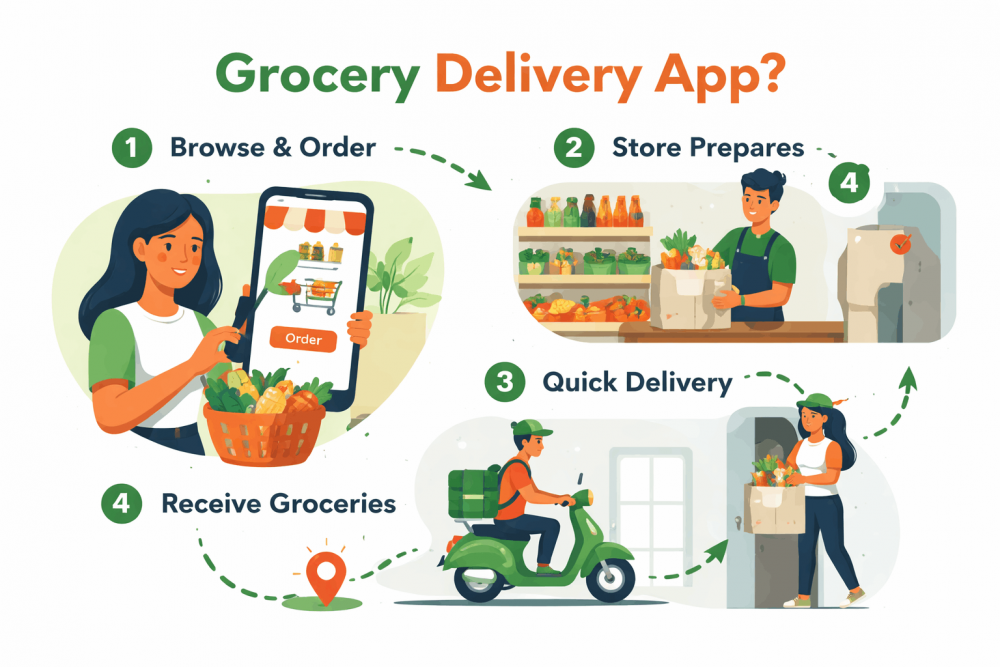
A grocery delivery app is a digital platform that allows users to browse grocery products, add items to a cart, place orders, make secure payments, and receive deliveries directly at their doorstep. Modern grocery ordering app development goes far beyond simple online ordering because it integrates real-time inventory, delivery logistics, payment systems, and customer engagement features.
In practical terms, a grocery app creates a bridge between the customer and the grocery business. The customer uses a mobile app or web platform to explore available products, while the store receives and processes orders instantly through an admin dashboard. Delivery partners then receive order assignments and complete deliveries based on route optimization
How the Grocery Delivery Process Works
The process begins when a customer opens the app and browses available categories such as fruits, vegetables, dairy products, packaged foods, beverages, household items, and personal care products. Advanced search filters help users quickly find items based on price, brand, weight, and discounts.
Once products are selected, the customer adds them to the cart and proceeds to checkout. During checkout, users choose:
Delivery address
Preferred delivery slot
Payment method
Promo codes or discounts
After payment confirmation, the store receives the order in real time. Inventory is updated instantly so that stock remains accurate across all users. Delivery agents are then assigned automatically, and customers can track their order live until delivery completion.
This is why today must include backend systems capable of handling multiple real-time actions simultaneously.
Core Modules in a Grocery Delivery App
A complete grocery platform usually contains:
Customer application
Delivery partner application
Admin dashboard
Vendor management app
Businesses planning online grocery shopping app development often also include web ordering systems to increase customer reach.
Benefits of Grocery Delivery App Development
The rapid growth of digital grocery shopping has created strong business opportunities. Companies investing in grocery delivery mobile app development gain both operational and commercial advantages.
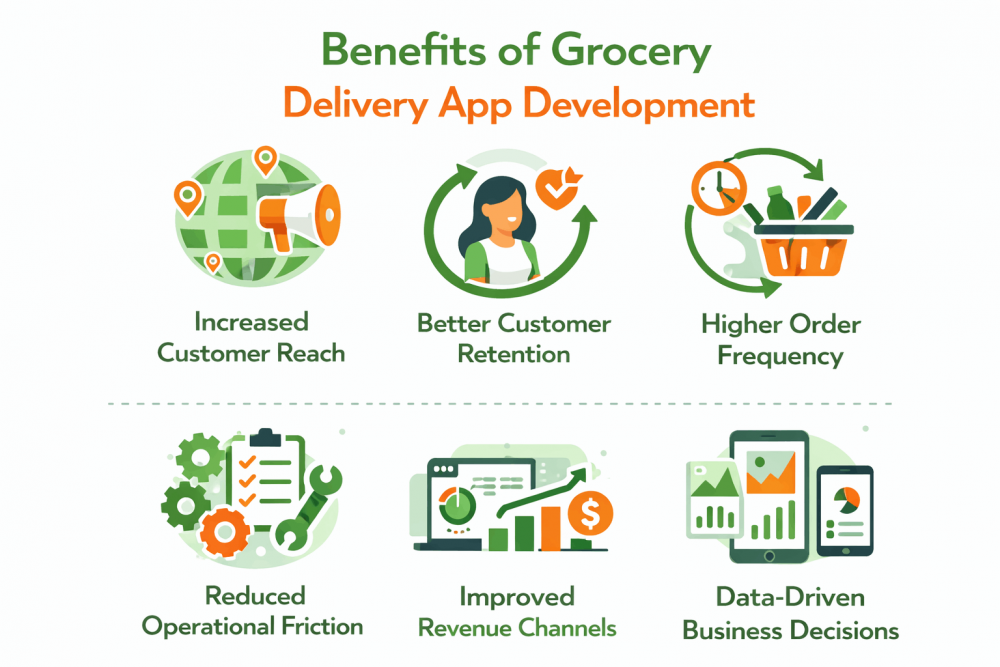
Increased Customer Reach
A physical grocery store is limited by location. A mobile app removes geographic limitations and allows businesses to serve larger areas. Through grocery store app development, even local stores can serve entire cities through delivery networks.
Better Customer Retention
Mobile apps allow businesses to maintain direct communication through push notifications, offers, reminders, and personalized promotions. Customers who receive relevant recommendations tend to order repeatedly.
Higher Order Frequency
Grocery products are purchased regularly, which means customers naturally return multiple times per month. This makes grocery app development highly valuable because repeat orders generate long-term revenue.
Reduced Operational Friction
Digital order systems reduce manual order taking, improve billing accuracy, and streamline inventory updates.
Improved Revenue Channels
A grocery app creates multiple earning streams:
Delivery fees
Product markups
Subscription memberships
Vendor commissions
Sponsored listings
Businesses using on demand grocery app development often combine several monetization models.
Data-Driven Business Decisions
Apps provide data on:
Best-selling products
Peak order times
Customer retention rates
Delivery efficiency
This helps businesses make smarter decisions.
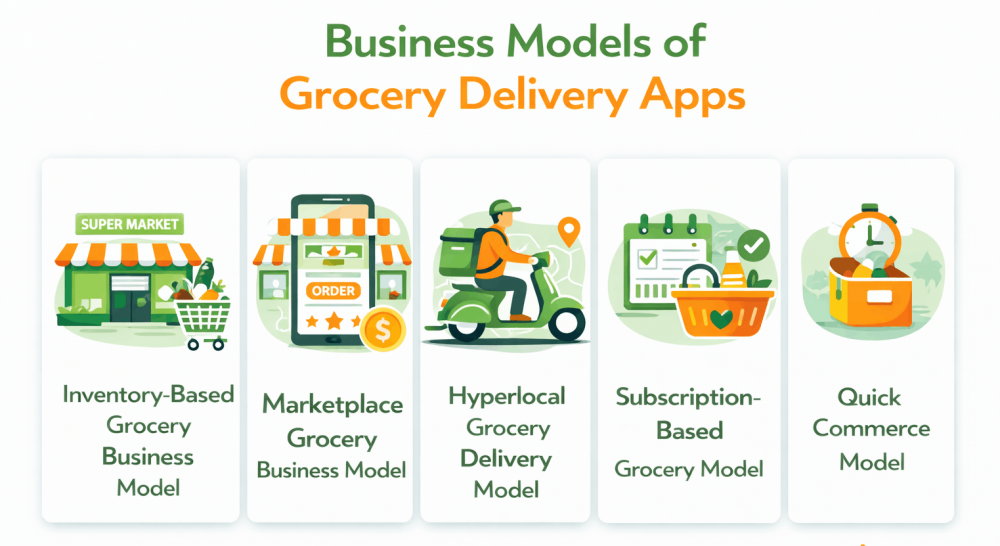
Prominent Business Models of Grocery Delivery Apps
Selecting the right business model is one of the most important decisions in grocery delivery app development because it directly affects revenue generation, logistics planning, inventory handling, and long-term scalability. A well-defined model helps businesses align technology investment with customer demand and market conditions. In modern grocery app development, companies often begin with one model and later evolve into a hybrid approach as their customer base grows.
The ideal model depends on several factors such as available budget, operational capacity, target geography, product sourcing strategy, and delivery expectations. Businesses planning grocery mobile app development should carefully evaluate how products will be stored, who will manage inventory, who will deliver orders, and how commissions or margins will be generated.
Below are the most successful business models currently used in grocery shopping app development and on demand grocery delivery app development.
1. Inventory-Based Grocery Business Model
In the inventory-based model, the business owns and manages its own grocery stock. Products are stored in warehouses, fulfillment centers, or physical retail stores, and every order placed through the app is fulfilled directly by the business itself. This model gives complete control over pricing, product quality, packaging, and delivery speed.
Businesses using this model usually invest heavily in storage infrastructure, inventory software, and fulfillment systems. Since stock is owned directly, margins can often be higher compared to marketplace models. However, operational costs are also significantly higher because warehousing, stock replenishment, and product wastage must be managed carefully.
This model is widely used by supermarket chains and established retailers because it supports strong brand consistency and better customer trust. For businesses planning grocery ordering app development, this model works well when product supply chains are already established.
Advantages of Inventory-Based Model:
Full control over stock and product quality
Better pricing flexibility
Stronger profit margins
Faster order fulfillment
Challenges:
High inventory investment
Risk of unsold perishables
Warehouse management complexity
2. Marketplace Grocery Business Model
The marketplace model is highly popular in online grocery app development because it allows multiple grocery vendors to sell through a single platform. Instead of owning products directly, the platform connects customers with independent grocery stores, supermarkets, and suppliers.
When a customer places an order, the platform forwards it to the selected vendor, and the vendor prepares the order for delivery. Revenue is usually generated through commissions charged on every order.
This model requires strong vendor management systems because each seller may have different pricing, stock availability, and delivery capabilities. Advanced online grocery shopping app development often includes vendor dashboards so each seller can update products, pricing, and stock independently.
Marketplace platforms scale quickly because new vendors can be added without large inventory investment.
Advantages of Marketplace Model:
Lower initial investment
Rapid business expansion
Multiple vendor participation
Large product variety
Challenges:
Vendor quality control
Inconsistent delivery standards
Complex vendor coordination
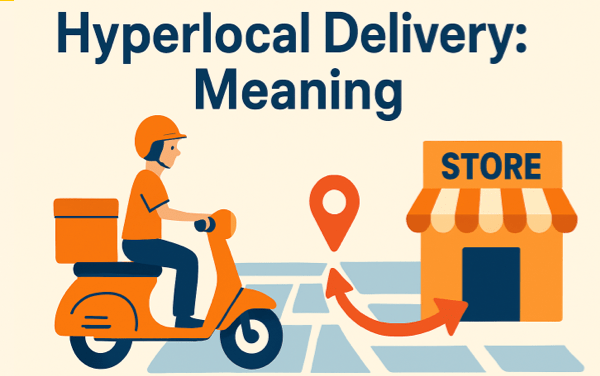
3. Hyperlocal Grocery Delivery Model
The hyperlocal model has become one of the fastest-growing structures in on demand grocery app development. In this model, products are sourced from nearby grocery stores and delivered within a defined local radius.
The app acts as a local digital bridge between nearby customers and nearby stores. Delivery partners collect items directly from neighborhood stores and complete deliveries quickly.
This model works especially well in urban areas where customers expect same-day or even one-hour delivery. Businesses planning to build grocery delivery app solutions for local markets often choose hyperlocal systems because they require less inventory investment.
Hyperlocal apps depend heavily on GPS, route optimization, and real-time order coordination.
Advantages of Hyperlocal Model:
Low inventory cost
Faster launch
Strong local market penetration
Quick delivery potential
Challenges:
Store dependency
Delivery delays during peak hours
Limited product consistency
4. Subscription-Based Grocery Model
The subscription model is increasingly used in grocery delivery mobile app development because it improves recurring revenue and customer loyalty. Customers pay monthly, quarterly, or yearly membership fees to receive benefits such as free delivery, priority delivery slots, exclusive discounts, or cashback rewards.
This model works particularly well when combined with other models because subscriptions create predictable revenue while encouraging repeat ordering.
Businesses using subscriptions often offer premium benefits like:
Unlimited free deliveries
Early access to discounts
Scheduled recurring orders
Special member pricing
This strategy helps reduce customer acquisition pressure by improving retention.
Advantages of Subscription Model:
Predictable recurring revenue
Higher retention rates
Increased order frequency
Challenges:
Strong value proposition required
Benefit management complexity
5. Quick Commerce Model
Quick commerce has become a major trend in grocery store app development. This model focuses on ultra-fast deliveries, often within 10 to 20 minutes.
To achieve this, businesses use micro-warehouses, dark stores, and strategically placed fulfillment centers. Products are stored close to demand zones, allowing delivery partners to fulfill orders rapidly.
Quick commerce demands highly optimized technology because inventory, dispatch, and route decisions happen instantly.
Businesses entering dense urban markets increasingly adopt quick commerce because customer demand for speed continues to grow.
Advantages of Quick Commerce Model:
Extremely fast delivery
Strong customer convenience
Competitive market positioning
Challenges:
High operational cost
Delivery pressure
Dense infrastructure requirement
6. Hybrid Grocery App Business Model
Many successful businesses now use hybrid models that combine multiple structures. A company may run inventory-based operations for high-demand products while also onboarding local vendors through marketplace systems.
Hybrid systems are becoming common in advanced online grocery store development because they maximize flexibility.
For example:
Own inventory for essentials
Marketplace vendors for specialty products
Subscription for premium customers
Hyperlocal delivery for fast service
This allows businesses to diversify revenue while reducing risk.
Which Grocery Business Model Is Best?
The best model depends on business goals, budget, and delivery expectations.
Startups often begin with hyperlocal or marketplace models
Before starting grocery delivery app development, businesses should clearly define:
Who owns inventory
Who handles delivery
How revenue will be generated
How technology will support scaling
Choosing the right model early creates a stronger foundation for long-term success in grocery app development.
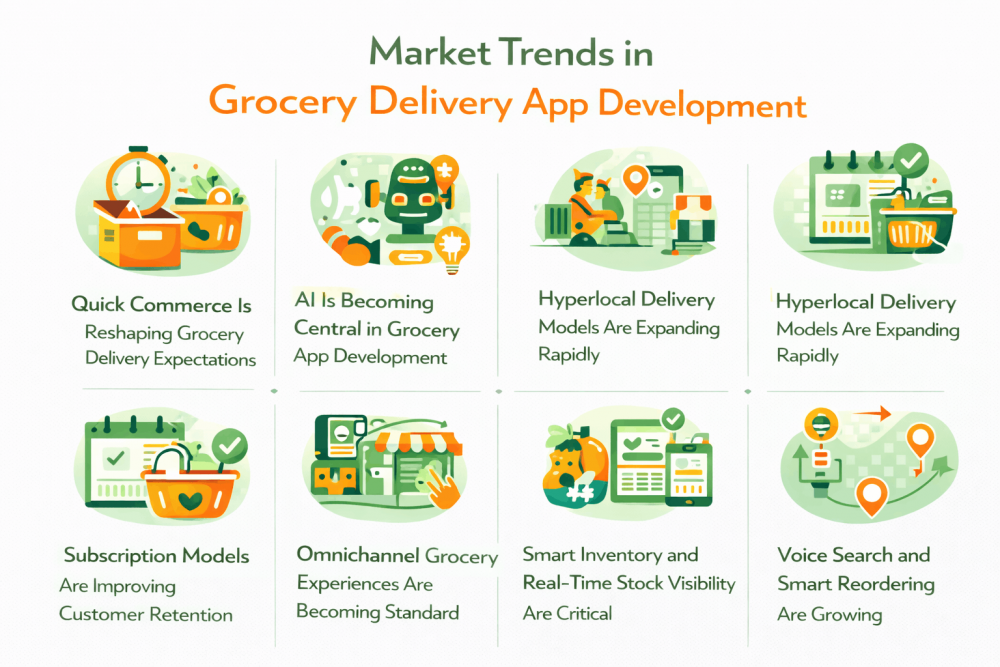
Market Trends in Grocery Delivery App Development
The grocery commerce industry is evolving rapidly, and current market behavior shows that grocery delivery app development is no longer limited to basic online ordering. Businesses now compete on speed, personalization, delivery intelligence, and customer retention. Global demand for digital grocery services continues to grow as consumers increasingly prefer convenience, flexible delivery slots, and real-time product availability. Recent market reports project steady long-term expansion, with the global grocery delivery app market expected to grow at a strong pace through the next decade as mobile-first buying habits continue to strengthen.
For businesses investing in grocery app development, understanding these market trends is essential because modern users now expect much more than product listings and checkout functionality. A successful platform must combine logistics efficiency, intelligent recommendations, and scalable digital infrastructure.
1. Quick Commerce Is Reshaping Grocery Delivery Expectations
One of the strongest trends in on demand grocery delivery app development is the rapid rise of quick commerce. Customers increasingly expect groceries within 10 to 30 minutes rather than traditional same-day delivery windows. This shift has pushed businesses to redesign fulfillment systems around micro-warehouses, dark stores, and hyperlocal delivery zones.
Large global and regional players are expanding rapid grocery delivery aggressively. For example, new grocery delivery rollouts in major cities are now targeting 15-minute fulfillment as a competitive standard, showing how delivery speed has become a key differentiator.
For companies planning build grocery delivery app solutions, this means delivery architecture must support:
Smart dispatch systems
Real-time route allocation
Local inventory clustering
Delivery zone optimization
Quick commerce is especially important in urban grocery mobile app development, where customers increasingly place small but frequent orders.
2. AI Is Becoming Central in Grocery App Development
Artificial intelligence is now one of the most important trends in online grocery app development. Grocery apps increasingly use AI to improve both customer experience and operational efficiency.
AI is used for:
Personalized product recommendations
Demand forecasting
Dynamic pricing
Automated replenishment
Delivery route prediction
Modern grocery systems analyze customer buying history to suggest repeat purchases, complementary products, and seasonal offers. This directly improves order value and retention. Recent industry data also shows AI-powered inventory systems are helping businesses reduce stockouts and optimize replenishment decisions.
Businesses investing in grocery shopping app development now increasingly prioritize recommendation engines because grocery customers purchase repeatedly and predictably.
3. Hyperlocal Delivery Models Are Expanding Rapidly
Hyperlocal delivery continues to dominate grocery ordering app development because it reduces inventory costs and enables faster launch.
Instead of owning all inventory, businesses partner with nearby stores and fulfill orders locally. This allows:
Lower startup cost
Faster city expansion
Reduced warehousing investment
This model has become especially popular in India and emerging markets where urban density supports local fulfillment. Major grocery systems are rapidly expanding hyperlocal operations into smaller cities, proving the model is no longer limited to metro areas.
For businesses planning grocery store app development, hyperlocal architecture remains one of the most scalable early-stage options.
4. Subscription Models Are Improving Customer Retention
Customer acquisition costs in digital grocery are rising, which is why many businesses now use subscription models inside grocery delivery mobile app development.
Subscription systems offer:
Free deliveries
Priority slots
Exclusive discounts
Cashback rewards
This trend improves predictable recurring revenue while encouraging higher order frequency.
For businesses focused on online grocery shopping app development, subscription logic helps reduce churn because users tend to stay longer once enrolled in premium benefits.
5. Omnichannel Grocery Experiences Are Becoming Standard
Consumers increasingly move between physical stores and mobile apps, which means online grocery store development must support omnichannel experiences.
Retailers now integrate:
Store pickup
App ordering
In-store QR browsing
Unified loyalty systems
Large retail companies are actively investing in digital discovery systems that connect offline and online shopping journeys more smoothly.
This means modern grocery app maker strategies should support both digital and physical retail integration.
6. Smart Inventory and Real-Time Stock Visibility Are Critical
One major customer frustration in grocery apps is ordering unavailable products. This is why modern grocery delivery app development increasingly focuses on live inventory synchronization.
Businesses now invest in:
Real-time stock APIs
Automated inventory updates
Product substitution logic
AI-supported inventory systems are reducing stock errors significantly and improving operational efficiency.
For companies building advanced on demand grocery app development systems, inventory accuracy directly affects retention.
7. Sustainability Is Influencing Grocery App Features
Research also shows even slight flexibility in delivery timing can significantly reduce transport emissions and delivery mileage.
This trend is influencing future grocery mobile app development, especially in urban regions.
8. Voice Search and Smart Reordering Are Growing
Frequent grocery purchases make voice-enabled shopping highly practical.
Apps increasingly support:
Voice product search
Saved shopping lists
One-tap reorder
Smart repeat purchases
This trend is especially important in grocery ordering app development because customers often buy recurring essentials rather than exploring new products.
9. Data-Driven Personalization Is Increasing Basket Value
Grocery businesses now use behavioral analytics heavily inside grocery app development.
Personalization includes:
Frequently bought bundles
Cross-category recommendations
Meal suggestions
Time-based promotions
Advanced recommendation systems are improving add-to-cart rates significantly by understanding basket context in real time.
10. Multi-City Expansion Is Driving Scalable Architecture
The latest market trend shows that grocery apps are no longer built only for single-city operations. Businesses increasingly launch with future expansion in mind.
This requires:
Multi-location inventory support
Multi-vendor architecture
Region-based pricing
Language localization
That is why scalable cloud infrastructure has become essential in build grocery delivery app projects.
Why These Trends Matter for Businesses
Businesses entering grocery delivery app development today must think beyond app launch. Success now depends on whether the platform can evolve with:
Delivery speed expectations
AI personalization
Subscription retention
Operational automation
Regional scalability
Companies that align with these market trends build stronger long-term digital grocery businesses.
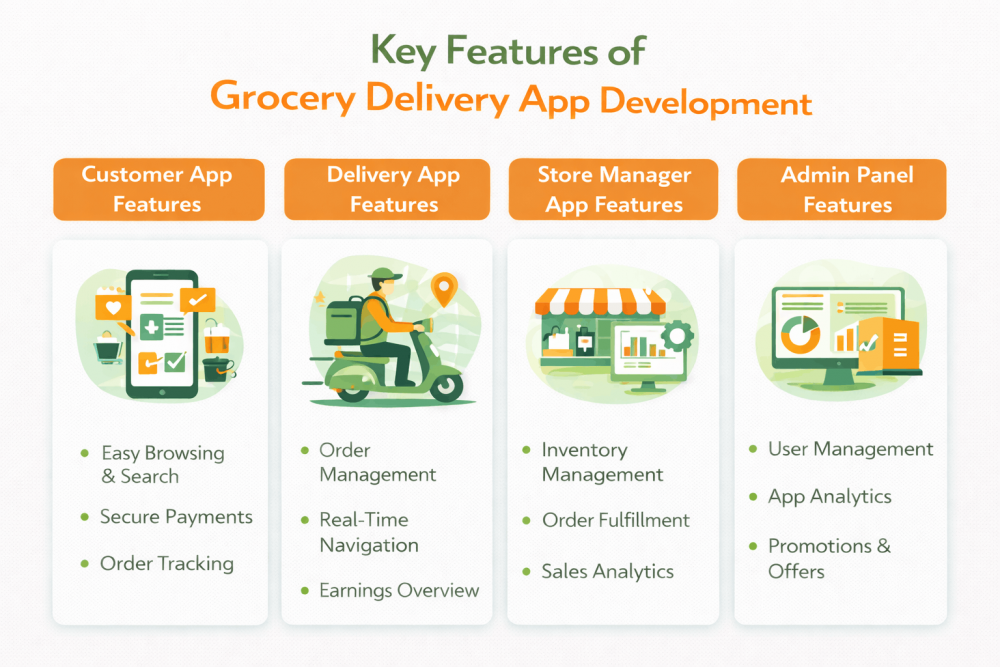
Key Features of Grocery Delivery App Development
A successful grocery delivery app development solution should include features for every user involved in the grocery system—customers, delivery agents, store managers, and administrators. In modern grocery app development, each component is designed to simplify operations, improve order accuracy, and ensure fast delivery.
Customer App Features
The customer app is the core of grocery mobile app development because it directly affects user experience and repeat purchases.
Easy Registration and Login
Customers should be able to sign up using mobile number, email, or social login for quick access.
Smart Search and Product Filters
Users should find products easily by category, brand, price, or discount, which is essential in grocery shopping app development.
Product Catalog with Details
Each product should display images, pricing, quantity, offers, and availability.
Cart and Smooth Checkout
Customers must be able to edit quantities, apply coupons, and complete checkout easily.
Multiple Payment Options
Support for UPI, cards, wallets, and cash on delivery is important in online grocery app development.
Delivery Slot Selection
Customers should choose preferred delivery time slots.
Real-Time Order Tracking
Live order tracking improves trust and transparency.
Reorder and Wishlist
Users can quickly reorder previous purchases and save favorite items.
Push Notifications
Useful for order updates, offers, and reminders.
Delivery App Features
The delivery app is essential in on demand grocery delivery app development because fast and accurate delivery improves customer satisfaction.
Order Assignment
Delivery agents receive orders automatically based on location.
Route Optimization
GPS helps choose the fastest delivery route.
Delivery Status Updates
Agents update order progress from pickup to delivery.
In-App Calling and Chat
Allows smooth communication with customers.
Earnings Dashboard
Delivery agents can track completed orders and payments.
Store Manager App Features
The store manager app is highly important in grocery ordering app development because it manages daily order fulfillment at the store level.
Order Acceptance and Processing
Store managers receive new orders instantly and begin processing them.
Product Availability Management
Managers update stock availability to prevent customers from ordering unavailable products.
Packaging Status Updates
Store staff can update whether an order is packed and ready for dispatch.
Inventory Monitoring
The store manager tracks stock levels and low inventory alerts.
Product Pricing Updates
Managers can update prices, offers, and discounts quickly.
Substitute Product Handling
If a product is unavailable, the manager can suggest alternatives.
Delivery Coordination
The store manager hands over ready orders to delivery agents.
Daily Sales Monitoring
Managers can track daily orders and store-level revenue.
This module is very useful in grocery store app development, especially when multiple stores operate under one platform.
Admin Panel Features
The admin panel controls the full system in online grocery shopping app development.
Inventory Management
Admins control product categories, stock, and catalog data.
Order Management
All orders can be monitored, assigned, and managed centrally.
Customer Management
Admins view customer activity, complaints, and order history.
Delivery Management
Admins monitor delivery performance and assign delivery teams.
Vendor Management
Important for multi-vendor online grocery store development platforms.
Promotions and Coupons
Admins create discount campaigns and referral offers.
Analytics Dashboard
Tracks revenue, top products, customer growth, and order trends.
Advanced Features
Modern build grocery delivery app projects also include:
AI product recommendations
Voice search
Loyalty rewards
Subscription plans
Multi-language support
A well-planned feature structure ensures strong performance in grocery delivery mobile app development and helps businesses scale efficiently.
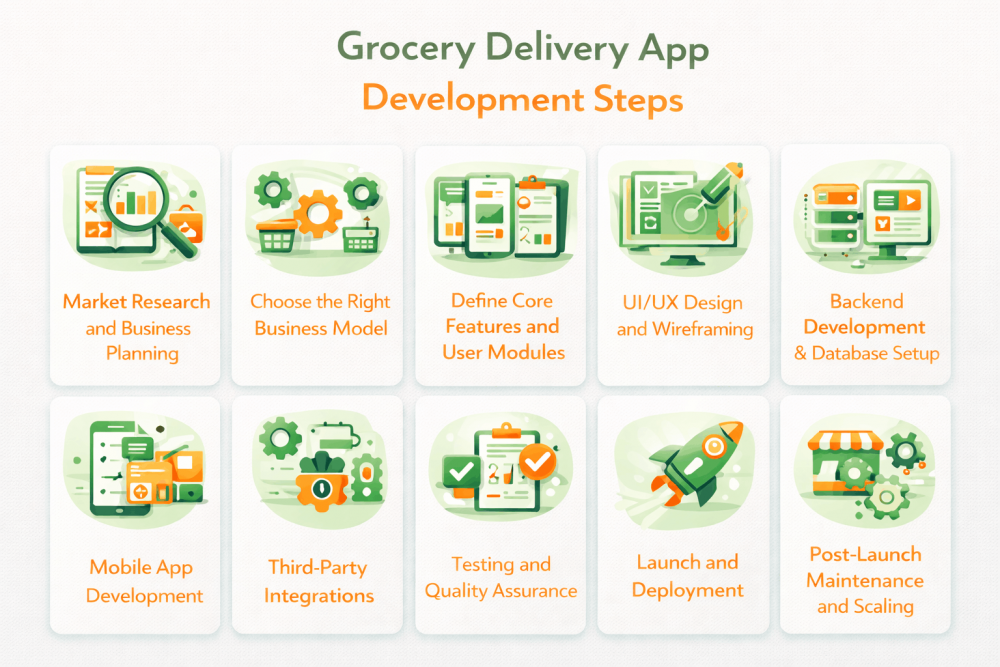
Grocery Delivery App Development Steps
Building a successful grocery platform requires a clear development roadmap because grocery delivery app development involves customer experience, logistics, inventory systems, and business operations working together. A structured process helps businesses reduce development risks, control costs, and launch faster. Whether you are planning grocery app development for a startup, supermarket, or multi-vendor marketplace, each stage plays an important role in long-term success.
1. Market Research and Business Planning
The first step in grocery mobile app development is understanding the market, customer expectations, and competitor strategies. Businesses should study:
Popular grocery delivery platforms
Customer buying behavior
Delivery expectations
Local market demand
Pricing models
At this stage, businesses also define whether they want hyperlocal delivery, multi-vendor marketplace, or inventory-based operations.
2. Choose the Right Business Model
Before starting development, businesses must decide how the platform will operate. In grocery shopping app development, common business models include:
Inventory-based model
Marketplace model
Hyperlocal model
Subscription model
The business model directly affects app architecture and revenue planning.
3. Define Core Features and User Modules
The next step is identifying features required for each app panel. In grocery ordering app development, businesses usually define features for:
Customer app
Delivery app
Store manager app
Admin panel
This stage also includes deciding whether advanced features such as loyalty rewards, AI recommendations, and subscriptions will be added.
4. UI/UX Design and Wireframing
A simple and intuitive interface is critical in online grocery app development because customers expect fast product discovery and easy checkout.
Design planning includes:
App screen structure
Navigation flow
Product layout
Checkout design
Delivery tracking screens
Good UI directly improves conversion rates.
5. Backend Development and Database Setup
The backend is the core of on demand grocery delivery app development because it handles orders, payments, inventory, and real-time updates.
Backend development usually includes:
API creation
User authentication
Inventory management
Order processing
Payment integration
A strong backend ensures the app can scale smoothly.
6. Mobile App Development
Once backend systems are ready, frontend app development begins. Businesses usually build:
Android app
iOS app
Optional web platform
Modern grocery delivery mobile app development often uses React Native or Flutter for faster cross-platform development.
7. Third-Party Integrations
To make the app fully functional, several external services are integrated:
Payment gateways
Google Maps
Push notifications
SMS services
Analytics tools
These integrations are essential in build grocery delivery app projects.
8. Testing and Quality Assurance
Before launch, complete testing is required to ensure smooth performance.
Testing includes:
Functional testing
Payment testing
Load testing
Security testing
Device compatibility testing
In online grocery shopping app development, testing is critical because grocery users expect reliability.
9. Launch and Deployment
After testing, the app is launched on:
Google Play Store
Apple App Store
Web servers
A soft launch is often recommended to collect early feedback.
10. Post-Launch Maintenance and Scaling
Development does not stop after launch. Businesses must continuously improve the platform through:
Feature updates
Performance monitoring
Bug fixing
Customer feedback analysis
This is especially important in grocery store app development because user expectations evolve quickly.
A well-planned development process helps businesses launch a stable platform and grow efficiently in the competitive grocery market.
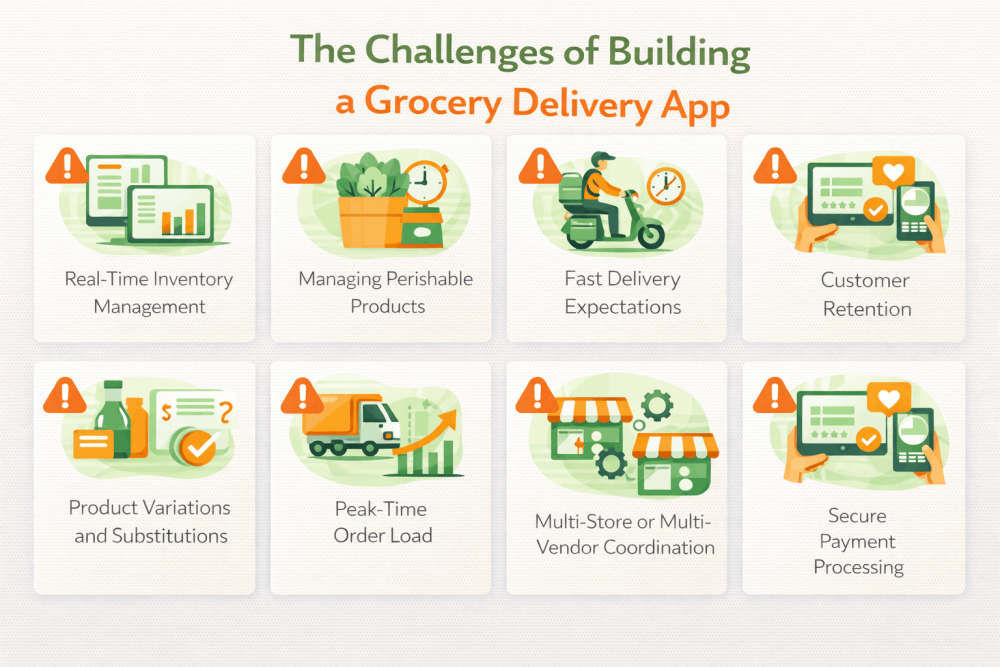
The Challenges of Building a Grocery Delivery App
Building a successful grocery delivery app development solution involves both technical and operational challenges because grocery businesses handle real-time inventory, frequent orders, and time-sensitive deliveries. In grocery app development, identifying these challenges early and planning practical solutions helps businesses launch a stable and scalable platform.
1. Real-Time Inventory Management
One of the biggest challenges in grocery mobile app development is keeping stock updated in real time. Grocery products can sell out quickly, and incorrect stock information may lead to cancelled orders.
Solution: Use real-time inventory synchronization, automated stock alerts, and instant product availability updates.
2. Managing Perishable Products
Fresh items like fruits, vegetables, dairy, and bakery products require careful handling because they have short shelf life.
Solution: Implement expiry tracking, freshness monitoring, and quick stock rotation systems inside the app.
3. Fast Delivery Expectations
Customers expect quick delivery, especially in on demand grocery delivery app development, where delivery delays directly affect customer satisfaction.
Solution: Use GPS tracking, route optimization, and smart delivery partner assignment to reduce delivery time.
4. Product Variations and Substitutions
Grocery products often come in different sizes, weights, and brands, which can create confusion during order processing.
Solution: Build clear product variation options and allow store managers to suggest substitute products when needed.
5. Peak-Time Order Load
High traffic during weekends, festivals, or promotions can slow app performance.
Solution: Use scalable cloud infrastructure so the system can handle large numbers of simultaneous orders.
6. Multi-Store or Multi-Vendor Coordination
In marketplace-based grocery shopping app development, different stores may have different pricing and stock availability.
Solution: Use centralized dashboards for vendor management, stock monitoring, and order control.
7. Secure Payment Processing
Payment failures can quickly reduce trust in online grocery app development.
Solution: Integrate secure payment gateways with multiple payment options and fast refund handling.
8. Customer Retention
Many businesses attract users but struggle to keep them active.
Solution: Use loyalty programs, discounts, personalized offers, and reorder features to improve repeat purchases.
Addressing these challenges properly helps businesses build stronger grocery ordering app development platforms that deliver smooth customer experiences and long-term growth.
Tech Stack for On-Demand Grocery Delivery App Development
Frontend Technologies
React Native
Backend Technologies
Node.js
Laravel
Databases
MySQL
MariaDB
Cloud Infrastructure
AWS
Essential Integrations
Google Maps
Payment gateways
Push notifications
A scalable stack supports future growth in grocery shopping app development.
Partner with Goteso to Build Your Custom Grocery Delivery App
In today’s competitive digital grocery market, choosing the right development partner is essential for launching a reliable and scalable grocery platform. Goteso specializes in grocery delivery app development for startups, supermarket chains, grocery retailers, and enterprises looking to build modern on-demand grocery solutions.
Our team delivers custom grocery app development solutions designed around business goals, customer behavior, and market trends. From intuitive customer apps to advanced admin dashboards, we build complete grocery ecosystems that support smooth ordering, real-time inventory, and efficient delivery management.
What We Offer
At Goteso, our grocery mobile app development services include:
Customer app for easy grocery ordering
Delivery app for order fulfillment
Store manager panel for inventory and order handling
Admin dashboard for complete business control
Custom Grocery Solutions for Every Business Model
We build solutions for different grocery business needs, including:
Whether you need grocery shopping app development for a local market or large-scale on demand grocery delivery app development, our solutions are built to scale.
Frequently Asked Questions (FAQs)
How much does grocery delivery app development cost?
The cost of grocery delivery app development depends on features, app complexity, number of user panels, and integrations such as payments, maps, and inventory systems. A basic solution costs less, while advanced multi-vendor platforms require higher investment.
How long does grocery app development take?
A standard grocery app development project usually takes 8 to 16 weeks depending on the scope, features, and platforms required for launch.
Which business model is best for grocery mobile app development?
The right model depends on your business goals. Hyperlocal, marketplace, and inventory-based models are the most common in grocery mobile app development.
What features are essential in grocery shopping app development?
Important features include product search, cart management, secure payments, delivery tracking, inventory control, and admin dashboard management.
Can grocery apps support multiple stores or vendors?
Yes, modern grocery shopping app development can support multiple stores, vendors, and delivery locations through centralized management systems.
Is real-time inventory important in online grocery app development?
Yes, real-time inventory is critical in online grocery app development because it prevents unavailable product orders and improves customer trust.
Can I build a grocery delivery app solution for both Android and iOS?
Yes, businesses usually build grocery delivery app solutions for both Android and iOS to reach a wider customer base.
Why choose a professional company for grocery ordering app development?
A professional development partner ensures scalability, secure integrations, strong backend systems, and long-term support for grocery ordering app development.
Does Goteso provide custom grocery delivery app solutions?
Yes, Goteso offers custom grocery delivery mobile app development solutions tailored to startups, grocery stores, supermarkets, and enterprise businesses.
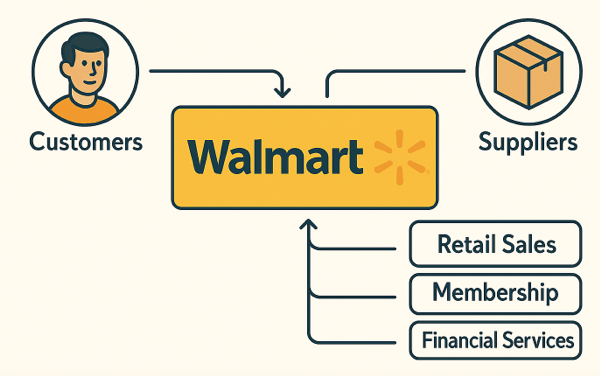
Walmart is one of the largest retail corporations in the world, with a presence in over two dozen countries and thousands of stores globally. Known for its “Everyday Low Prices,” Walmart has built a powerful ecosystem that dominates retail both offline and online. In this blog, we’ll explore the Walmart business model, understand how Walmart makes money, break down how Walmart works, and analyze the Walmart revenue model in detail.
Understanding the Walmart Business Model
The Walmart business model is based on high-volume, low-margin retailing. Walmart operates on a cost leadership strategy, meaning it offers products at lower prices than competitors by keeping operating costs low and leveraging its massive scale for better supplier deals.
At its core, Walmart is a multi-channel retailer, combining physical stores with an e-commerce platform to serve customers across different touchpoints. It targets price-sensitive consumers and focuses heavily on supply chain optimization, private labeling, and vendor relationships.
How Walmart Works
To understand how Walmart works, we need to look at several key components:
1. Massive Supply Chain Network
Walmart has one of the most sophisticated and efficient supply chains in the world. It uses advanced logistics, real-time data analytics, and inventory management systems to keep products moving smoothly from suppliers to shelves.
2. Vendor Partnerships
Walmart uses its buying power to negotiate favorable terms with manufacturers and suppliers, helping it offer lower prices. It often requires suppliers to use Walmart’s own logistics systems to streamline operations further.
3. Private Label Brands
Walmart boosts profit margins with its own in-house brands like Great Value and Equate. These private label products are cheaper to produce and offer better control over quality and pricing.
4. Brick-and-Mortar + E-commerce Integration
Walmart integrates its physical stores with its online platform (Walmart.com), enabling services like in-store pickup, curbside pickup, and local delivery — a true omnichannel experience.
How Walmart Makes Money
Let’s break down how Walmart makes money:
1. Retail Product Sales
This is Walmart’s core source of revenue. It sells a wide variety of goods including groceries, electronics, apparel, household items, and more. Its low-price strategy ensures high customer footfall and repeat purchases.
2. Membership Programs
Walmart+ is a subscription service that offers free delivery, fuel discounts, and other perks. It’s a direct competitor to Amazon Prime and adds a recurring revenue stream to Walmart’s business.
3. E-commerce Sales
Walmart has heavily invested in e-commerce and now generates billions through online sales. It also operates a third-party marketplace, allowing other sellers to list products — a model similar to Amazon.
4. Advertising Revenue
Walmart Connect is the company’s advertising platform. Brands pay Walmart to advertise products across its digital and physical retail space. This is a fast-growing, high-margin revenue stream.
5. Financial and Other Services
Walmart offers financial services like money transfers, credit cards, and installment payments. These services generate fees and attract more customers to its ecosystem.
Walmart Revenue Model Breakdown
The Walmart revenue model is diversified but still heavily dependent on retail sales. Here’s how it’s structured:
Revenue Source
Contribution (%)
Notes
Product Sales (In-store & Online)
~90%+
Groceries, general merchandise, private labels
Membership Fees
Small but growing
Walmart+ subscriptions
Advertising (Walmart Connect)
Growing rapidly
High-margin digital ads
Financial Services
Small but profitable
Includes money services and payment platforms
Walmart reported over $600 billion in revenue in its most recent fiscal year, making it the world’s largest company by revenue.
Final Thoughts
The Walmart business model is a powerful example of operational excellence, scale, and cost efficiency. By understanding how Walmart works, including its supply chain, retail strategy, and tech investments, we get a clearer picture of how Walmart makes money.
Whether it’s through aggressive pricing, e-commerce expansion, or advertising monetization, the Walmart revenue model is built to dominate — and evolve.
Want to Launch Your Delivery Service Like Walmart?
Inspired by Walmart’s success and thinking of launching your own delivery platform? Contact Goteso – the best on demand delivery app development company. Goteso specializes in building custom, scalable, and user-friendly grocery delivery apps tailored to your business needs. Whether you’re a startup or an enterprise, their tech solutions can help you compete with the giants and grow faster in the digital economy.
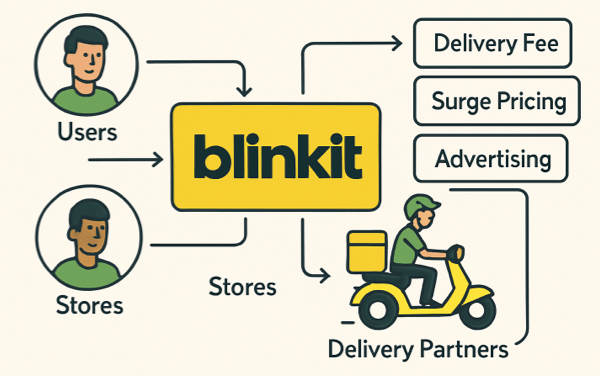
In the age of instant gratification, Blinkit (formerly Grofers) has emerged as a leading player in India’s ultra-fast grocery delivery space. Promising delivery in 10–20 minutes, Blinkit has redefined convenience for urban consumers. But how does this lightning-fast service generate revenue? In this blog, we break down the Blinkit business model, explore its operations, and explain how Blinkit makes money.
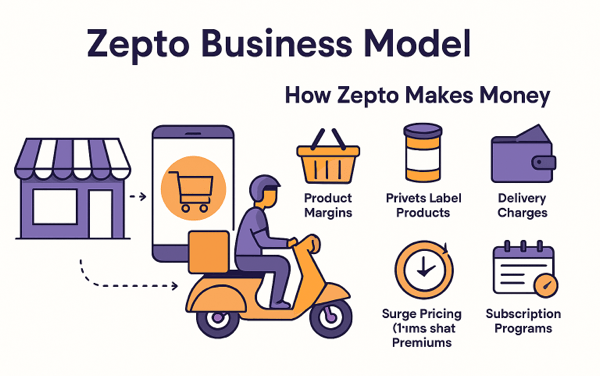
India’s quick commerce revolution is well underway—and leading the charge is Zepto, the 10-minute grocery delivery app that’s transforming how urban India shops. With lightning-fast deliveries, a tech-driven approach, and an expanding customer base, Zepto has positioned itself as one of the fastest-growing startups in the country.
In today’s fast-paced world, grocery delivery apps have become a game-changer for busy households across the United States. Whether you’re a working professional, a busy parent, or someone who just prefers the convenience of shopping from home, Top 10 Online Grocery Delivery Apps in the USA make it easier than ever to get fresh produce, pantry staples, and household essentials delivered right to your door.
In today’s fast-paced digital world, convenience and speed are not just preferences—they’re expectations. The hyperlocal delivery model has emerged as a game-changer, bridging the gap between local businesses and nearby customers. From groceries and medicines to food and personal care products, hyperlocal services are transforming how goods move across neighborhoods.
In the post-pandemic era, the demand for grocery delivery apps has skyrocketed, transforming how consumers shop and how grocery businesses operate. As consumer expectations evolve, grocery shopping apps are no longer a luxury—they’re a necessity. At Goteso, we specialize in building high-performance grocery mobile apps that help retailers and startups thrive in the digital age.
In an era of on-demand convenience, traditional business models are rapidly evolving—and the dairy industry is no exception. With the growing demand for fresh milk and dairy products delivered right to consumers’ doorsteps, investing in milk delivery app development has become essential for modern dairy businesses. Whether you own a local dairy shop or manage large-scale dairy operations, Goteso—a trusted milk delivery app development company—is your perfect tech partner to go digital and scale efficiently.
Creating a grocery delivery app in 2026 involves a combination of strategic planning, design, development, and deployment. Below is a detailed guide to help you create a grocery delivery app effectively.
If you’re considering developing an instant grocery delivery app, there’s never been a better time. The on-demand economy is booming, and consumer expectations for speed, convenience, and quality are higher than ever. From fresh produce to pantry staples, users are turning to instant grocery delivery apps that promise speed and simplicity.
Shopping from an online grocery store is a trend these days as you get the things delivered at your doorstep. It is imagined to be one of the next level things for the startups. But in the last few years, many of the grocery businesses took a major step and entered the E-commerce industry, but failed to prove themselves. The failure in the same led to the slow withdrawal of startups and compelled most of the new startups to quit.
With intense competition, every e-tailing business is getting strong online business presence to target potential consumers in their local niche market. Each B2B (business to business) and B2C (business to consumers) business in grocery retailing are adopting uber for x model to raise their monthly revenue and sales with better customer engagement techniques.